Slope Walker
A visual proof that in gradient descent, how far you step matters just as much as which direction you step.
“The moment I imagined gradient descent as someone walking down a hill, everything clicked. So I built the hill.”
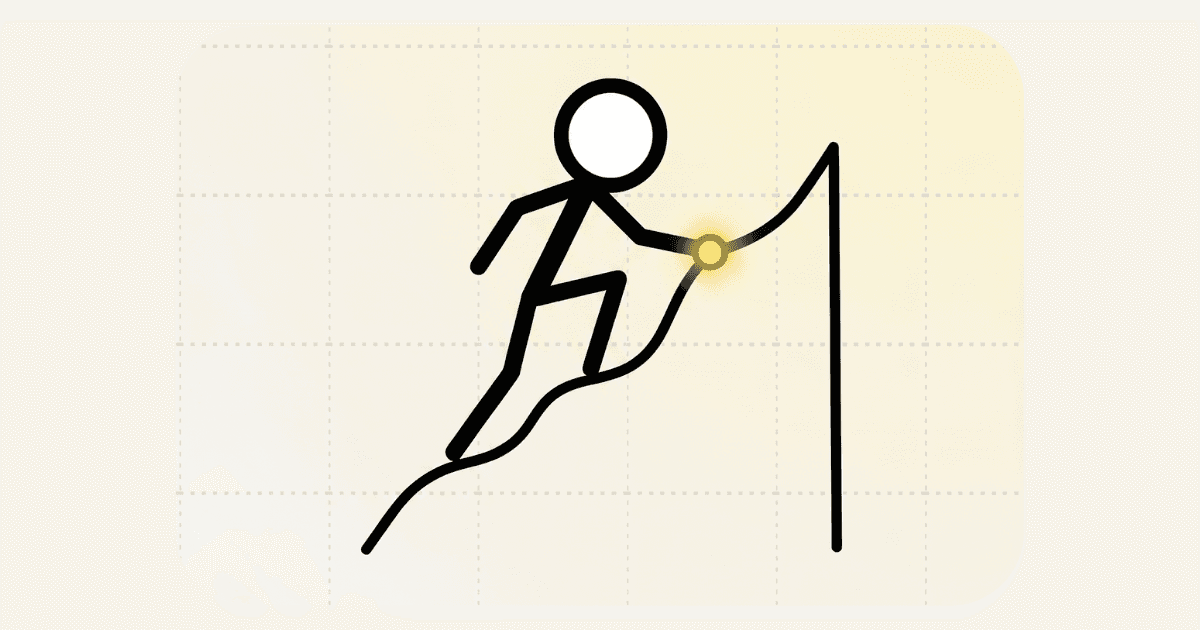
When I started learning about gradient descent, I understood it conceptually but I couldn't feel it. I could follow the math, but something wasn't connecting—especially around step size. Why did it matter so much? Too large and the algorithm overshoots; too small and it barely moves. The concept clicked the moment I stopped thinking about it as an equation and started thinking about it as a person walking down a hill. If you take huge steps, you might leap right over the lowest point. If you take tiny steps, you'll get there eventually—just very slowly. Slope Walker turns that thought experiment into an actual visualization: a stick figure descends a parabola, and every adjustment to the step size changes the walk in real time. I later had the opportunity to use a demo of this app to explain gradient descent to my multivariable mathematics class—an opportunity my professor gave me—and watching the concept land for my classmates through the visualization made me genuinely happy. It's a simple tool, but sometimes simplicity is exactly what a concept needs.
Step Size Control
Adjust the step size in real time and watch the stick figure's path change instantly. Overshoot the minimum, crawl toward it, or converge cleanly—all by moving a single slider.
Parabolic Slope
The descent plays out on a parabola—the canonical shape for understanding quadratic loss functions and the intuition behind minimization.
Classroom-Ready
Simple enough to show in a lecture, clear enough to make the concept land immediately. I used this in my multivariable mathematics class, and it worked.